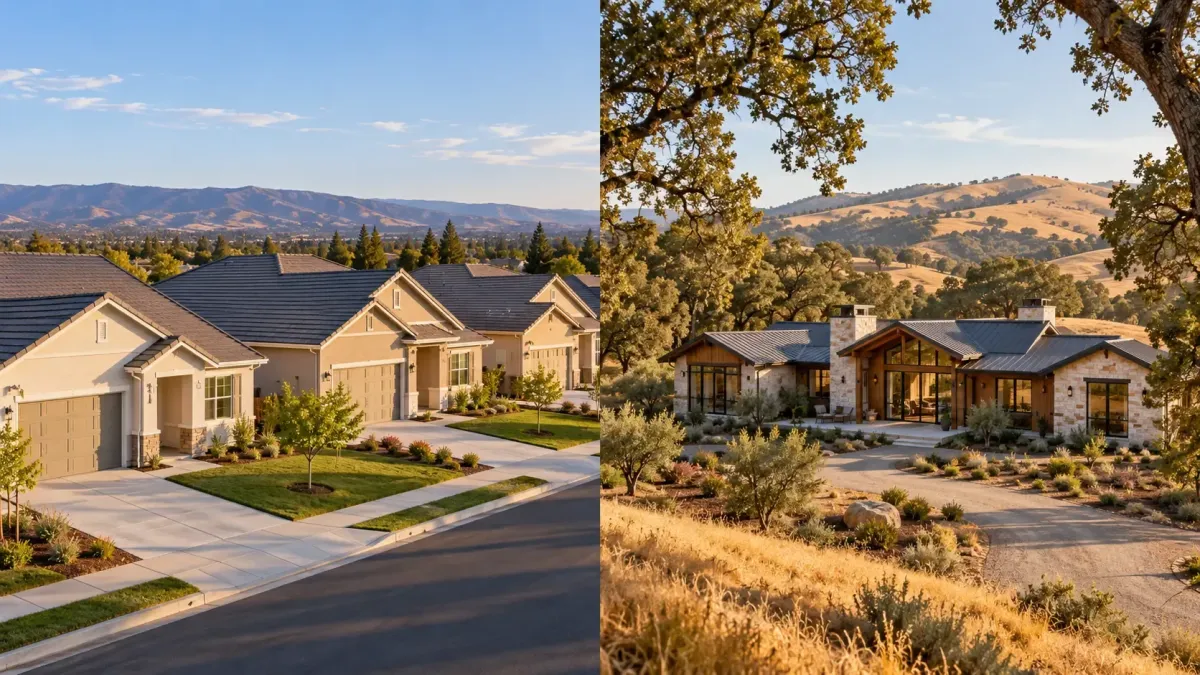
Production Builder vs. Custom Builder the Key Differences
Trying to picture your future home can get weirdly confusing fast. One minute you are walking through a polished model home, the next you are standing on a dusty lot outside Chico wondering if a house should be designed around that view, that slope, and the oak tree you do not want to lose. That is where the production builder vs custom builder question starts to matter, because these two paths are built for very different priorities.
Production builder vs. custom builder: What’s the difference?
A production builder builds many homes from a set group of plans, options, and finishes. A custom builder builds your home around your lot, your layout, and your goals, with far fewer preset limits.
That is the core split. Production building is about speed, repeatability, and more predictable pricing. Custom building is about personalization, site-specific design, and a more hands-on process. If a production home is like ordering from a menu with a few good substitutions, a custom home is more like cooking from scratch in your own kitchen.
Neither path is automatically better. One is better for a certain kind of project, budget, and personality.
What a production builder actually does
A production builder usually builds multiple homes at the same time, often in the same neighborhood, using a library of floor plans and finish packages. “Production” does not mean cheap or poorly built by default. It means systemized. The work is organized to be repeated efficiently, over and over, with fewer surprises.
In the national market, that scale can be massive. The largest builders close tens of thousands of homes a year, which gives you a sense of how different this model is from a one-off custom build. The point is volume, consistency, and keeping the process moving.
How the production model works
The production model runs on repetition. A builder may offer six floor plans, four elevations, and a menu of cabinets, counters, flooring, fixtures, and appliance packages. Crews already know the plans. Suppliers already know the material list. The schedule is built around doing the same kinds of tasks again and again.
That system creates real advantages. Materials can be bought in bulk. Trade crews can move from house to house without learning a brand-new design each time. Selections get narrowed to what the builder can price, order, and install efficiently. All of that tends to make cost and timing easier to predict.
Here is the thing: that predictability is the main reason many people choose this path. You are not reinventing the wheel. You are choosing a wheel that the builder has already rolled successfully many times.
Where production builders usually build
Production builders usually build in neighborhoods the builder controls, often as home-and-land packages. That can mean a subdivision, a master-planned community, or a builder-led development where you choose a lot and a model together.
This setup is convenient. One sales process, one package, and a neighborhood that already has a clear look and feel. In some communities, that also means shared amenities like parks, trails, or a clubhouse.
The tradeoff is less freedom. You may have HOA rules. The homes around you may look similar. Lot orientation, privacy, and backyard shape might not line up perfectly with how you want to live. If you want a home in a neat, planned neighborhood, that may sound great. If you want breathing room on the edge of town, maybe not.

What a custom builder actually does
A custom builder creates a home around your land, your plan, and your priorities instead of asking you to pick from a preset menu. That is the simplest definition, and honestly, it clears up a lot of confusion.
Custom does not automatically mean giant or fancy. A modest single-story ranch can be fully custom if it is designed for your lot, your budget, and the way you actually live. The word “custom” describes the process more than the size.
How the custom process works
The custom path is more collaborative, and it starts earlier than many people expect. Before walls go up, there is usually a chain of decisions involving land, plans, budget, engineering, permits, site prep, selections, and construction details.
You are usually more involved from the start. That can mean reviewing layouts, adjusting room sizes, deciding where windows should face, talking through storage, and weighing tradeoffs between one feature and another. You get more control, but you also get more decisions.
The catch is that every decision can affect cost, timing, or both. Move a wall, and framing changes. Change the footprint, and foundation cost may shift. Add larger windows toward a view, and energy performance, structure, and price all need another look. That does not make custom harder in a bad way. It just means the process is more connected.
Where custom builders usually build
Custom homes are often built on land you already own or plan to buy. That could be an infill lot in town, a rural parcel outside Chico, or a homesite with slope, trees, views, or privacy that would not work well with a standard plan.
This matters a lot in the Chico area. Plenty of people are not looking for a tight subdivision lot with the same front setback as every house next door. You may want space for a shop, room between neighbors, or a layout that opens toward the foothills instead of toward the street.
That is where custom building shines. Instead of forcing the lot to fit the plan, the plan fits the lot.

The biggest difference: flexibility vs. efficiency
This is the heart of the whole comparison. Production building is about getting a proven home with fewer choices and fewer moving parts. Custom building is about shaping the house around how you live, even if that takes longer and costs more.
If you hate making a hundred design decisions, production can feel like relief. If you have strong opinions about layout, light, storage, and how your house should sit on the land, custom can feel like the only path that makes sense.
What you can usually change with a production builder
With a production builder, you can usually change surface-level items and a few plan options. That might include the elevation, cabinet style, countertops, flooring, paint colors, plumbing fixtures, and maybe a room conversion such as turning a flex room into an office.
But the basic structure is often locked in. Major layout changes, square footage shifts, or moving windows and walls are commonly limited or not allowed at all, especially once construction has reached a certain point.
That limited menu is not a flaw. It is the system working as designed.
What you can usually change with a custom builder
With a custom builder, much more is open for discussion. Room sizes, storage, traffic flow, ceiling details, window placement, kitchen layout, exterior style, finish level, and the way the home faces the lot can all be shaped around your priorities.
Site-specific design is the phrase you will hear a lot. In plain English, it means the house is planned for your land instead of dropped onto it like a prepacked kit. If your best view is to the west, the living spaces can follow that. If your lot slopes, the foundation and layout can respond to it instead of fighting it. If privacy matters more than curb appeal, the window placement can reflect that.
Land and location: this choice changes everything
Lot strategy is one of the biggest practical differences between these two paths. In fact, if you already own land, your builder options may narrow almost immediately.
That is why so many people get clarity once they stop asking, “What kind of house do you want?” and start asking, “Where is it going to sit?”
Production builders usually sell the lot with the house
Production builders usually package the lot with the home. That makes the buying process simpler because the builder has already evaluated the site, planned the community, and matched home designs to those lots.
You get convenience and fewer unknowns. You also get less say in the exact setting. Your backyard depth, driveway placement, orientation to the sun, and amount of privacy are all shaped by the community plan. The house may fit the lot well enough, but it was not created just for that lot.
Custom builders often start with your lot
Custom builders often begin with land you already own or want to buy. That means the lot itself becomes part of the project from day one. Utilities, access, grading, drainage, setbacks, zoning, deed restrictions, and tree protection can all affect what is possible and what it costs.
That sounds like a lot because it is. Before buying land, it helps to understand how local permit and approval steps usually work, especially in Butte County where site conditions can vary quite a bit from one parcel to another.
Sloped lots, mature trees, and rural properties often cost more to prep. But those same conditions can create a better home in the end because the design responds to the land instead of flattening every difference out.
Cost differences: upfront price vs. long-term fit
Production homes usually cost less upfront. Custom homes usually cost more. That part is simple.
What is less simple is why, and whether that extra cost buys something you will care about for years.
Why production homes are often easier to price
Production builders usually offer clearer base pricing because the plans, materials, and workflow are standardized. Repetition keeps costs tighter. Bulk buying helps too. Some production homes can cost 15 to 30 percent less than a similar custom home, mostly because the process is so systemized.
There is also current market pressure working in your favor on this side. In August 2026, 35% of builders reported cutting prices, and many were still using incentives to keep sales moving. That does not mean every deal is amazing. It does mean production builders are working hard to keep homes within reach.
The trick is to watch the upgrade sheet. A low base price can climb quickly once you start adding premium flooring, cabinetry, appliances, and lot premiums.
Why custom homes usually cost more
Custom homes usually cost more because more things are unique. You may pay for design work, engineering, surveys, site prep, utility runs, grading, septic or well work, permit coordination, and one-off details that would never appear in a production subdivision.
Pricing is also less standardized. A flat lot near existing utilities is one kind of project. A rural parcel with a long driveway, slope, and tree constraints is another. Even before you pick finishes, the land itself can swing the budget.
This is one reason custom building is often described as less rate-sensitive and more tied to buyer resources. In fact, custom builders were reporting stronger conditions than spec builders in 2026, especially in higher-end parts of the market.
The long-term value question
Value is not just resale price. It is also daily use.
A house with the right storage in the right places feels better every single day. A kitchen that fits how you cook matters more than a trendy backsplash. A laundry room near bedrooms, better light in the living area, and a garage layout that actually works can spare you years of small frustrations.
That said, custom only pays off if the design truly matches your life. If you overspend on flashy details you do not care about later, the value gets thin fast.
Timeline: faster move-in or more build time
Production is usually faster. Custom usually takes longer. Not because anybody is dragging feet, but because the work is different.
Typical production timeline
A production home can move fairly quickly, especially if the plan is already permitted, already started, or nearly finished. Many production homes fall into a rough three- to six-month build range, and some inventory homes can be ready even sooner.
The builder is not figuring everything out from scratch. Plans are tested, crews are scheduled, and the sequence is familiar. That speed is a real advantage if your timing matters more than design freedom.
Typical custom timeline
A custom home often takes longer, sometimes nine to twelve months or more once the full process is counted. Here is where it gets interesting: the house is not the only thing being built. The process is too.
Land review, design, revisions, engineering, permits, and site prep all happen before the main structure really gets moving. On a rural Chico-area parcel, utility planning alone can add time. If the lot has slope, access issues, or trees, expect more preconstruction work.
That slower pace is not wasted time. It is the cost of getting a house that fits instead of just finishes.

Your experience during the build will feel very different
Even if two homes end up looking equally nice, the experience of getting there can feel completely different.
What building with a production builder feels like
Production building usually feels more guided. You tour model homes, pick a plan, visit a design center, make selections from a menu, and move through preset milestones. Communication is often organized through sales staff, construction updates, and scheduled walkthroughs.
This fits you well if you want a clearer path and less decision fatigue. You still make choices, but not endless choices.
What building with a custom builder feels like
Custom building usually feels more involved because it is. You may review plan revisions, walk the lot, discuss allowances, compare options, and make decisions that affect both budget and function.
That takes time and attention. But if you want more say in how your house lives day to day, that involvement is the whole point. Before signing with anyone, it helps to spend time figuring out what makes a builder a good match, because communication style matters just as much as portfolio photos.
Quality, craftsmanship, and materials: not as simple as people think
A common myth says production means cheap and custom means perfect. Real life is messier than that.
Quality depends on builder standards, crew consistency, supervision, and what is actually written into the project scope. A beautiful brochure proves almost nothing.
Where production builders can have an edge
Production builders can be very good at repeatable quality. When the same plan is built again and again, construction details get refined. Crews know where problems tend to show up. Scheduling is tighter. Mistakes caused by one-off improvising can be reduced.
There is a reason this model works at scale. Builders on the national Builder 100 list do not close that many homes by winging it. Systems matter.
Where custom builders can have an edge
Custom builders often have more room to focus on detail, function, and material choice. If you care about better cabinet layout, a different insulation approach, window placement tied to views, or construction methods that suit a particular lot, custom builders can often go further.
That edge is not just about prettier finishes. It is about solving real-life problems before they become daily annoyances. A mudroom in the right place, deeper pantry storage, a shaded porch that actually works in August, those are custom wins too.
Which option makes more sense for you in chico?
This decision gets clearer when you bring it back to your actual life in Chico, not a generic national checklist.
Smaller and less dense markets have been holding up relatively better in recent housing research, which matters here because land, privacy, and lot fit often carry more weight than in a dense metro setting. Custom building can make a lot of sense if your goal is a home that fits the land and your long-term plans. Production building can make just as much sense if your goal is a simpler path into a new home with fewer unknowns.
A production builder may be the better fit if…
A production builder may fit better if you want a faster move-in, easier budgeting, fewer choices, and a neighborhood package where the lot and home come together in one process. It also fits if you would rather not spend months making design decisions.
A custom builder may be the better fit if…
A custom builder may fit better if you already own land, want the layout shaped around your lot, care more about function than speed, need flexibility, or expect to stay long enough for the personalization to matter every day.
Questions to ask before you choose any builder
The right questions can save you from expensive surprises. The goal is not to impress anybody. The goal is to spot fit early.
Questions about budget and allowances
Ask what is included in the base price and what is only an allowance, meaning a budget placeholder rather than a final fixed item. Ask what commonly changes after contract and how overages are handled. If you are building on land, ask exactly how site work is estimated and what conditions could raise cost later.
Questions about plans, changes, and communication
Ask how much you can customize, and when changes stop being allowed. Ask who your main contact will be once construction starts. Ask how updates are shared, weekly emails, software portal, phone calls, site meetings, or something else. A good answer here makes the whole process feel less foggy.
Questions about land and site readiness
Ask whether the builder works on owner-owned lots at all. Ask who handles permits, what site issues commonly raise cost, and whether zoning or deed restrictions could block the plan you want. On a custom project, these questions are not side details. They are part of the budget.
Common questions about production builders vs. custom builders
Is a custom home always more expensive?
Usually, yes, at least upfront. But not always in the way people assume. If you load a production home with upgrades and lot premiums, the gap can shrink, especially compared with a right-sized custom home built around a smart plan.
Can you make changes to a production home?
Yes, usually within a limited option menu and within certain deadlines. Finish choices are common. Major structural changes are often restricted or not allowed.
Is custom only for luxury homes?
No. Custom just means the home is designed around your needs and your lot instead of chosen from a preset package. A simple home can still be fully custom.
Which one has better resale value?
Resale depends more on location, design choices, quality, and market demand than on the label alone. A well-designed custom home can hold strong appeal, especially if it fits the area and avoids overly personal choices.
What if you already own land near chico?
Owning land often pushes the choice toward a custom or semi-custom path. Many production builders prefer to build in neighborhoods they control, not on scattered owner-owned lots.
A simple way to decide
If your top priorities are speed, simpler choices, and more predictable pricing, start with production builders. If your top priorities are control, lot fit, and a home that works the way you actually live, start with custom builders.
The best first step is simple: write down your three non-negotiables before you tour a model home or walk a piece of land. That short list will make the right path a lot easier to spot.
