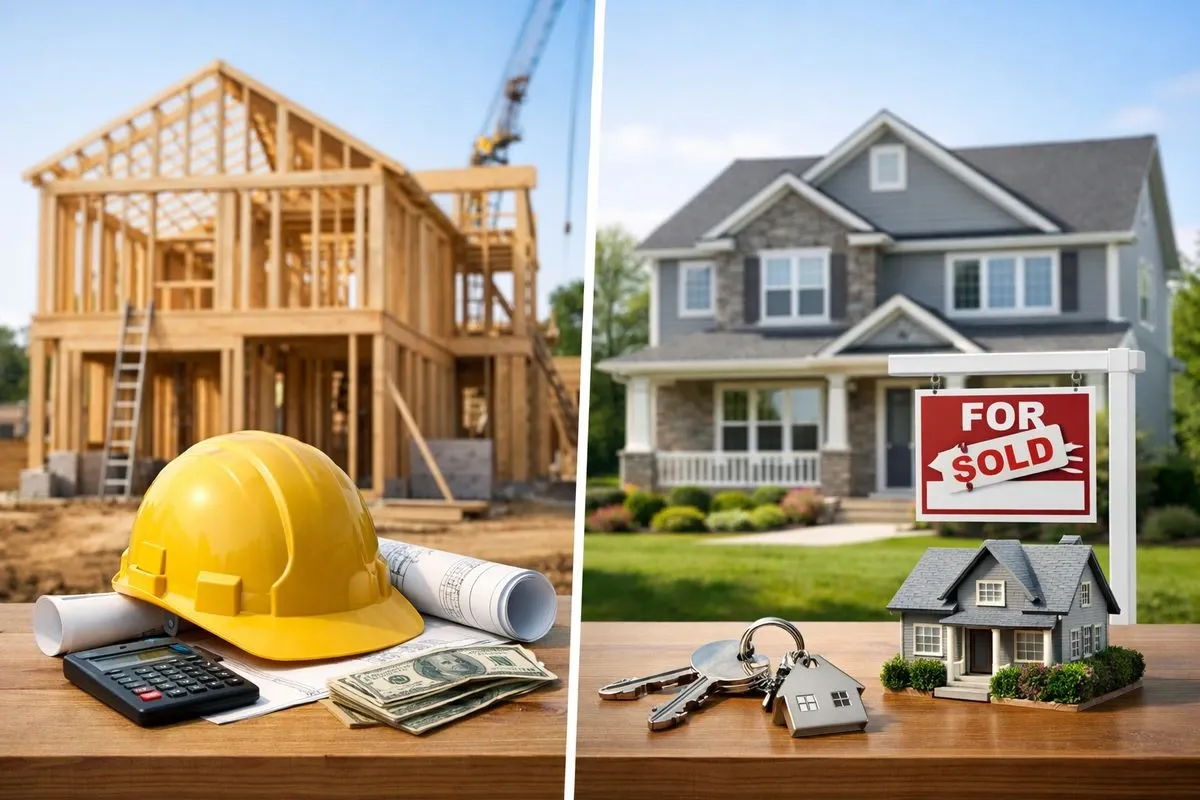
Is It Cheaper to Build or Buy a House?
Trying to answer is it cheaper to build or buy a house can feel weirdly simple at first. You look at a listing, look at a builder’s price per square foot, and think one of these has to be the obvious winner. But the real answer shows up in all the costs that hide off to the side, especially if you’re looking around Red Bluff, where a piece of land outside town can seem affordable right up until the well, septic, grading, and power bill show up.
Quick answer: buying is usually cheaper, but the catch is in the details
For most people, buying an existing home is cheaper than building from scratch. That is the straight answer.
Buying usually wins because the house already sits on a finished lot with access, utilities, permits handled, and neighborhood infrastructure in place. You are not paying separately for the driveway, trenching, hookups, plan review, or months of construction financing on top of the house itself. You are paying one price for a home that already works.
The catch is that building can make sense in a narrower set of situations. If you already own land near Red Bluff, or your family needs a layout that is hard to find in the resale market, the math can shift. Not always enough to make building cheaper, but enough to make the extra cost worth it.
That distinction matters. Cheaper and better are not always the same thing.

Build vs. buy at a glance
At a high level, buying usually wins on cost, speed, and simplicity. Building usually wins on control, personalization, and early-year maintenance. If your main goal is to spend less money and move sooner, buying is the safer bet. If your main goal is to get exactly the house you want and you have patience plus cash reserves, building starts to look better.
The reason this decision gets confusing is that each path hides costs in different places. Buying puts more of the total into the visible purchase price. Building often spreads the cost out across land, site work, permits, and upgrades, so the first number can look lower than the true final number.
What “building” includes in this comparison
Building is not just the contractor’s quote. It includes buying land, paying for plans, engineering, permits, site preparation, utility connections, foundation work, construction, inspections, loan costs, and the final work that makes the property usable, like a driveway or basic landscaping.
That shortcut, looking only at the builder’s base price, is where budgets go sideways. A house shell is not the same thing as a finished, move-in-ready home on a usable lot.
What “buying” includes in this comparison
Buying is not just the listing price either. It includes your down payment, closing costs, inspection fees, appraisal, insurance, property taxes, immediate repairs, and any updates you want after move-in.
So yes, the list price matters. But it is only the opening number. A house with an old roof and a tired HVAC system can get expensive fast, even if the offer price looks good.
Upfront cost: sticker price vs. total project cost
This is where a lot of people get tripped up. A resale home can look expensive because the full price is visible right away. A build can look cheaper because the contractor quote seems manageable on its own. But those two numbers are not measuring the same thing.
Nationally, building a house has been cited in a wide range, while average home prices have hovered higher than some raw construction quotes. That sounds like building should win, right? Not so fast. Raw construction cost is not total project cost.
Why existing homes usually win on upfront affordability
Existing homes usually come with the lot, driveway, utility hookups, zoning, and road access already handled. That saves you from paying for each of those pieces separately. It also means fewer surprise invoices.
So if you want the direct answer to is it cheaper to build or buy a house, here it is: buying an existing home is usually cheaper upfront and often cheaper overall. That is especially true when you compare similar size, similar location, and full all-in costs.
You might still pay more on paper for the home’s purchase price. But that one price often includes a lot of expensive work that a build budget leaves out at the start.
Why new builds often start lower than they finish
New builds have a way of growing. Not because anybody is trying to trick you, though vague bids do happen, but because construction has more moving parts than most people expect.
Material prices move. Labor gets tight. Code requirements add upgrades. A light fixture allowance turns out too low for what you actually want. Soil needs more work than expected. A “change order,” which just means a paid change to the original plan, shows up every time you swap or add something.
On top of that, construction prices stay elevated because of labor shortages, material swings, stricter codes, and higher compliance costs. So the number you start with is often not the number you finish with.
Land and site prep
Land is the part people forget most, and it is often the reason building loses the cost battle. Raw land can be like buying a cheap printer that needs expensive ink, cables, and software before it does anything useful.
A pretty parcel is not the same as a build-ready lot.
Buying land in and around red bluff
In and around Red Bluff, lot cost can vary a lot based on distance from town, road access, zoning, slope, and utility availability. A parcel a little outside central Red Bluff can look like a bargain at first glance. Then you learn it needs a well, septic, grading, driveway work, and trenching for power, and suddenly the “cheap” land is not cheap anymore.
Tehama County adds its own local flavor to this math. Rural lots can offer privacy, room for a shop, and space to breathe. But rural lots also tend to ask more from your budget before a single wall goes up.
Clearing, grading, utilities, and access
Site work is where reality arrives. Clearing trees, grading the pad, excavating, trenching, cutting a driveway, bringing in water, connecting sewer or installing septic, and getting power to the home can eat through money fast.
This section is often what turns a good-deal lot into a much more expensive project. If the parcel is uneven, rocky, remote, or heavily wooded, costs go up. If utility lines are far away, costs go up. If the driveway needs to cross drainage or rough ground, costs go up again.
And none of this is optional. A beautiful floor plan on unusable land is just paper.
Permits, impact fees, and local compliance
Before construction really gets rolling, you still have permits, plan review, and code compliance to deal with. Depending on the property and local requirements, you may also face utility fees, school-related fees, or fire-safety upgrades.
This part is not flashy, but it is real money. It also tends to arrive early, which matters when you are trying to manage cash flow.
Buying an existing home skips most of this drama. You still pay closing costs and inspections, but you are not funding a local approval process piece by piece before you even move in.

Construction costs vs. repair and renovation costs
Both paths come with surprise spending. The difference is where it happens.
When you build, the biggest spending bucket is construction itself. When you buy, the biggest extra bucket is often repairs, updates, and catch-up maintenance. That means buying can still be cheaper overall, but only if you budget honestly for the work the house needs.
What drives new construction costs higher
New construction costs are driven by labor, concrete, framing, roofing, insulation, windows, cabinets, finishes, and mechanical systems like heating and cooling. Then code steps in and raises the bar, often for good reason. Energy standards, ventilation rules, fire safety, and structural requirements can all improve the house while also raising the bill.
That is the frustrating part. A higher build price is not always waste. Sometimes it is paying for a better-insulated wall, safer electrical work, or more efficient HVAC equipment. Useful upgrades still cost money.
What you may need to fix after buying
With an existing home, your money tends to go toward what time has worn down. Roofs age. HVAC systems lose efficiency. Plumbing can leak. Windows can be drafty. Kitchens and bathrooms can feel stuck in another decade.
Still, that does not automatically make buying the wrong move. In many cases, paying for a few repairs after closing is cheaper than funding land purchase, site work, and full construction from scratch. The trick is not pretending those repairs do not exist.
The homes that usually work best for budget-focused buyers are the boring good ones. Solid roof. Decent systems. No scary inspection report. Maybe the countertops are not thrilling, but the house itself works.
Move-in-ready homes vs. fixer-uppers
Move-in-ready homes often sell at a premium because buyers want fewer headaches. In a market where contractor pricing is high and renovation timelines drag, move-in-ready properties have a real advantage.
Fixer-uppers can still be worth it, but only if the discount is large enough to cover the repairs plus the hassle. “Cheaper” sometimes just means you pay later, while living with dust, delays, and a half-finished kitchen.
Financing and cash needed to close
Affordability is not just about the total price. It is also about how hard the money is to get and how much cash you need sitting ready.
That is where buying usually feels simpler.
Traditional mortgage for buying a home
A standard mortgage for an existing home is more predictable. You get preapproved, shop within your range, make an offer, go through inspection and appraisal, then close. You still need a down payment, closing costs, and some reserves, but the process is familiar and relatively straightforward.
That predictability matters. It helps you plan your cash needs, monthly payment, and move-in timeline with fewer surprises.
Construction loans, land loans, and draw schedules
Financing a build is a different animal. You may need a land loan if you do not own the lot yet, then a construction loan to fund the build, or a construction-to-permanent loan that converts into a regular mortgage later.
A draw schedule simply means the lender pays out money in stages as the work gets completed. Sounds simple enough, but it adds inspections, paperwork, and timing issues. If the project slows down, the money flow can get awkward too.
This is one reason financing a new build often feels more complex than buying a resale home. More steps, more approvals, more places for stress to sneak in.
Why building often requires more cash cushion
Building usually needs a bigger cash cushion because the unexpected is built right into the process. Overruns, delays, upgrades, and site surprises are common enough that planning for them is just normal.
That is why affordability should never mean only monthly payment. It should also mean how much risk your savings can absorb without turning every delay into a crisis.

Timeline and speed to move in
Speed changes the answer more than people expect. If you need a place to live by a certain date, buying becomes much more attractive.
Buying is usually faster and more predictable
Buying usually takes less time. Even if you spend a while searching, once you are in contract, the process is fairly linear: inspection, appraisal, loan approval, escrow, closing, move-in.
And in a market with more inventory and slower pace, buyers often have more breathing room. National data has shown homes listed for 78 days before an accepted offer on average, which gives buyers more room to compare options and negotiate than in the frenzy years.
Building takes longer and has more moving parts
Building takes longer because every phase depends on the one before it. Design leads to approvals. Approvals lead to site work. Site work leads to foundation. Then framing, roofing, rough-ins, insulation, drywall, finishes, inspections, punch list.
It is less like flipping a switch and more like a relay race. If one runner stumbles, everybody behind gets delayed.
And yes, a build can take more than a year. Even a smoother project is still a long chain of steps that has to hold together.
What delays really cost you
Delays are not just annoying. They cost money.
If construction drags, you may be paying rent longer, storing furniture longer, extending a rate lock, or living in temporary housing. Even a modest delay can add thousands once you stack those costs together.
That hidden cost rarely shows up when people casually compare a builder quote to a home listing.
Monthly ownership costs after move-in
Once the keys are in your hand, the spending keeps going. This is where total cost of ownership matters more than the headline price.
Insurance, taxes, and utilities
Both new and existing homes come with property taxes, insurance, and utility bills. And insurance deserves attention right now because it has gotten much more expensive. In many markets, homeowners insurance has climbed sharply since 2021 and keeps rising.
That means your monthly housing cost may increase even if your mortgage stays fixed. A newer home may help with some insurance and utility costs, but it does not erase them.
Maintenance: older home repairs vs. brand-new systems
Older homes tend to ask for more repairs sooner. New construction usually gives you a quieter start because the roof, HVAC, appliances, plumbing, and electrical systems are all brand new.
That early maintenance advantage is real. But it does not automatically make building cheaper. It just means part of the higher upfront cost may buy you a few years with fewer repair calls.
For any home, regular upkeep matters. A common budgeting rule puts maintenance and repairs at 2% to 4% of a home’s value each year. Older homes tend to lean toward the higher end.
HOA fees and neighborhood costs
Either option may come with HOA dues or neighborhood-related costs. A new subdivision might have monthly dues. An older neighborhood might not, but could still carry higher commuting costs or utility quirks.
The point is simple: compare the full monthly carry, not just principal and interest. The mortgage is only one piece of what the house costs you to keep.

Energy efficiency and long-term savings
New homes usually run cheaper month to month. Better insulation, tighter windows, newer HVAC systems, and modern code standards all help.
But lower bills do not automatically cancel out a much higher construction budget.
Where new builds tend to save money
New builds tend to save money through better insulation, higher-efficiency heating and cooling, modern windows, better air sealing, and smarter layouts. A tighter home keeps cooled air inside in Red Bluff summers, which can make a noticeable difference on utility bills.
That kind of efficiency starts paying back right away. The house feels more comfortable too, which is not just a spreadsheet issue.
When an older home can still compete
An older home can still compete if it has already been updated. Newer windows, added insulation, a recent HVAC system, solar, or good natural shade can narrow the gap a lot.
This is why you should never assume every resale house is an energy hog. Some older homes have had the right upgrades done already, which lets you skip the construction premium while still getting reasonable monthly bills.
Payback: when efficiency does and does not justify the build
Efficiency helps most when the price gap between building and buying is not huge. If a new build costs far more upfront, lower utility bills may take many years to make up the difference.
So yes, energy savings matter. But they usually work better as a tiebreaker than as the main reason to spend substantially more.
Customization and getting the home you actually want
This is where building shines. If you care deeply about layout, storage, accessibility, or how the house sits on the lot, buying can feel like shopping for shoes that almost fit.
Why building wins on personalization
Building gives you control over the floor plan, kitchen flow, storage, bedroom setup, office space, outdoor living, garage size, and special features like wide hallways or a zero-step entry.
That is not just luxury talk. For some households, custom design solves real daily-life problems. A multigenerational setup, a big workshop, RV parking, or a specific accessible bathroom layout can be hard to find in existing inventory.
The limits of buying an existing house
Buying means compromise. Maybe the lot is great but the closets are tiny. Maybe the kitchen is dated. Maybe the location is perfect but the layout is awkward.
Still, compromise is not always bad. If the house works well enough and the price is right, accepting a few imperfections can save you a lot of money and time.
The price of every change
The catch with building is that every little change has a price tag. An allowance is just a budget placeholder for items like lighting, tile, or cabinets. If your taste runs above that number, you pay the difference. A change order is an official paid change to the plan once construction is moving.
This is where customization starts to feel amazing and expensive at the same time. A better faucet here, bigger windows there, upgraded counters, extra outlets, different doors, and suddenly your budget is wearing a thousand paper cuts.
Neighborhood, location, and lot quality
A house is not just walls and finishes. Location often matters more than the house itself over time.
Existing homes often win on established neighborhoods
Existing homes tend to sit in established neighborhoods with mature trees, closer-in lots, developed streets, and easier access to schools, shopping, and day-to-day errands.
Those things are hard to recreate from scratch unless you pay up for a premium lot. An older neighborhood with big shade trees and a short drive into central Red Bluff can be worth a lot, even if the house needs some updating.
Building may win if you want space or a specific setting
Building can win if you want room to spread out, privacy, views, a shop, animal space, or a very specific setting outside denser parts of town.
That appeal is real in the Red Bluff area. For some households, the land is part of the dream, not just the place under the house.
How location changes the cost equation
A cheaper build farther out may mean longer drives, more utility setup, more road work, and fewer nearby services. So even if the land costs less, the lifestyle cost can be higher.
That is why “cheaper land” is not the same as “cheaper project.” Distance changes both budget and daily routine.
Stress, decision load, and project risk
Price matters, but so does what the process asks from you. This part gets ignored too often.
Buying has stress, but it is shorter-lived
Buying can be intense. You deal with listings, offers, inspections, negotiations, financing, and the rush of closing. But the hard part is concentrated into a shorter stretch of time.
Once you close, the giant wave of decisions mostly calms down.
Building asks more from you over time
Building keeps pulling you back in. Plans, bids, selections, delays, site questions, finish choices, budget revisions, inspections, timeline updates. It is exciting, but it also behaves like a part-time job for a while.
If you enjoy details, that may be fine. If your schedule is already packed, it can get old fast.
How to be honest about your bandwidth
Here’s the thing: your budget is not just money. It is also time, patience, and tolerance for uncertainty.
If you want a simpler path, buying usually fits better. If you have strong cash reserves, flexibility, and the energy to stay involved over months, building becomes much more realistic.
Resale value and long-term flexibility
Your plans can change. Job shifts happen. Family needs change. A house that works today may need to sell tomorrow.
Existing homes and neighborhood comps
Existing homes usually come with better comparable sales, often called comps. That makes value easier to judge when you buy and often easier for future buyers to understand when you sell.
Predictability has value. You are not inventing a price story from scratch.
New builds and modern appeal
New builds can have strong resale appeal because buyers like updated layouts, efficient systems, and fresh finishes. But there is a catch. Personal design choices do not always pay you back.
A dream feature for you can be a weird extra cost for somebody else.
Which option protects your future options better
If you may move, refinance, or sell within a few years, buying in a solid existing neighborhood often gives you more flexibility. If you plan to stay a long time and use the home exactly the way you want, building can still make sense even if it costs more upfront.
The shorter your horizon, the more buying tends to win.
Pricing comparison: sample cost breakdown for build vs. buy
Looking at both paths side by side helps a lot, even without a table. The point is not to pin down an exact number for every property. The point is to stop the extra costs from hiding.
Example budget for buying an existing home
Picture a well-kept existing home listed at $420,000.
Your down payment might be 10%, or $42,000. Closing costs could land around $8,000 to $12,000 depending on loan details and prepaid items. Add inspection fees, insurance, taxes, and moving costs, and you may need roughly $55,000 to $60,000 in cash to close and settle in. Then add maybe $10,000 to $20,000 for immediate repairs or updates if the home is solid but not perfect.
That puts your practical first-year cash need closer to $65,000 to $80,000, with a move-in-ready house and a clearer timeline.
Example budget for building a similar home
Now picture building a similar-size home.
Start with land at $95,000. Add design and engineering costs. Add permits and reviews. Add site prep, grading, driveway work, utility connections, septic or sewer work, and trenching. Then add the actual construction contract, plus loan fees, interest during construction, a contingency fund, and at least basic landscaping so the property functions.
A build quote for the house itself may look reasonable at first. But once the whole project is stacked together, the total can easily climb well above the all-in cost of buying a comparable existing home.
That is the part people do not see coming.
Why the cheaper option can flip in certain cases
The cheaper option can flip if you already own land, the lot is easy to build on, utilities are close, and the homes for sale in your target area are overpriced or need major renovation.
That is the narrow lane where building gets competitive. It still is not automatically cheaper, but the gap can shrink fast if the expensive pieces are already solved.
When buying is the better choice
If your top goals are affordability, predictability, and speed, buying is usually the right move.
Choose buying if you need predictable costs
Existing homes are usually safer for tighter budgets because the total cost is easier to see upfront. You still need reserves, but there are fewer wild-card categories than with a custom build.
That matters a lot if you want to protect your savings instead of pouring every spare dollar into the project.
Choose buying if you need to move sooner
If your lease is ending, school timing matters, or a job move is forcing the issue, buying makes more sense. It is usually the faster route by a wide margin, especially if you need to be settled within the next few months.
Choose buying if local inventory has good value
If you find a well-kept resale home in Red Bluff with a sound roof, decent systems, and a fair price, that can beat new construction by a lot once total costs are counted.
In a market with more inventory, buyers also tend to get a little more leverage than in a shortage market, which can improve the math even more.
When building is the better choice
Building can still be the right decision. Just not because it is magically cheaper in most cases.
Choose building if you already own land
This is the biggest reason the math changes. If your lot is already paid off and build-ready, you have removed one of the largest cost barriers right away.
That does not guarantee a cheaper total, but it shrinks the gap more than almost anything else.
Choose building if you need specific features you cannot find
If you need a very particular floor plan, accessible design, a shop, multigenerational living space, or serious RV storage, building can solve problems that resale homes keep failing to solve.
Paying more upfront can be worth it if the alternative is years of compromise plus expensive remodeling later.
Choose building if your timeline and cash reserves are flexible
The best build situations usually involve patience and breathing room. If a delay would wreck your finances or living plans, that is a warning sign. If you have flexibility, the process gets much easier to absorb.
Red bluff, CA considerations that can change your answer
National advice only gets you so far. Red Bluff has local realities that can push the answer one way or the other.
Local land, utilities, and rural-site costs
In the Red Bluff area, rural or edge-of-town lots can look appealing for good reason. More space, more privacy, more freedom. But those lots can also bring septic, wells, grading, driveway work, and fire-related site planning into the budget.
That combination can change your total faster than almost anything else. A parcel off a quiet road outside town may feel like the dream on a Saturday afternoon drive. Then Monday arrives with bids for trenching, pad prep, and utility work.
Existing home inventory vs. custom-home appeal
If local inventory has a decent supply of solid resale homes, buying becomes even easier to justify. If inventory feels stale, dated, or badly laid out for what you need, the pull of building gets stronger.
This is where local market shopping matters. You are not choosing between abstract ideas. You are choosing between actual houses and actual lots.
Working with a local builder and setting a real contingency
If you are leaning toward building, detailed bids matter. Ask what is included, what is excluded, what allowances are based on, and what site assumptions were made. A vague number is not a helpful number.
Also, keep a real contingency fund. Not a hopeful one. One that can absorb site surprises, upgrades, and delays without knocking the whole project sideways.
Verdict: is it cheaper to build or buy a house?
Yes, there are exceptions. But for most people, buying wins.
It is usually cheaper, faster, simpler to finance, and easier to predict. Building wins on customization and can make sense if you already have land, need something highly specific, or plan to stay long enough to fully enjoy the tradeoff.
The winner on cost for most people: buying
Buying usually comes out ahead because the land, access, utilities, and much of the uncertainty are already wrapped into one price. Once you count site prep, financing complexity, delays, and contingency money, building often costs more than it looked like it would.
So if your main question is purely about cost, buying is the stronger answer.
The winner in specific situations: building
Building earns its place when the lot is already in hand, the site is straightforward, your needs are highly specific, and your budget can handle some uncertainty.
In those cases, you are not chasing the cheapest option. You are paying for fit.
One smart next step to try
Take one house size, one target area, and one realistic finish level, then price both paths all the way through. Get one estimate on a resale home and one estimate from a local builder that includes land, site work, permits, utility setup, and contingency.
That one exercise will cut through more confusion than hours of online scrolling ever will.
Frequently asked questions
Is it ever cheaper to build than buy a house?
Yes, but it is not the common outcome. Building can compete if you already own land, the lot is easy to develop, utilities are nearby, and comparable homes for sale are overpriced or need major repairs.
How much extra should you budget when building a house?
A contingency fund is a must. Exact amounts vary, but you should expect extra money for site surprises, upgrades, permit changes, and delays. If your budget only works when nothing goes wrong, it is too tight.
Why does building a house end up costing more than expected?
The usual reasons are land development, utility hookups, grading, permit costs, material price changes, labor shortages, and change orders during construction. The base builder quote rarely tells the whole story.
Are older homes always more expensive to maintain?
Not always. A well-kept older home with updated roof, HVAC, plumbing, and windows can be a better value than a neglected newer-looking house. Age matters, but condition matters more.
Is buying land and then building a house a smart move in red bluff?
It can be, especially if you want space, privacy, or a custom setup. But the smart move depends on the lot. A parcel near utilities with simple access is very different from rural land that needs a well, septic, grading, and long power runs.
What is the simplest way to compare building vs. buying?
Use the same target home size, same area, and full all-in numbers for both options. For buying, include closing costs, repairs, insurance, and taxes. For building, include land, plans, permits, site work, utility connections, loan costs, contingency, and basic exterior work. That side-by-side math usually makes the answer much clearer.
